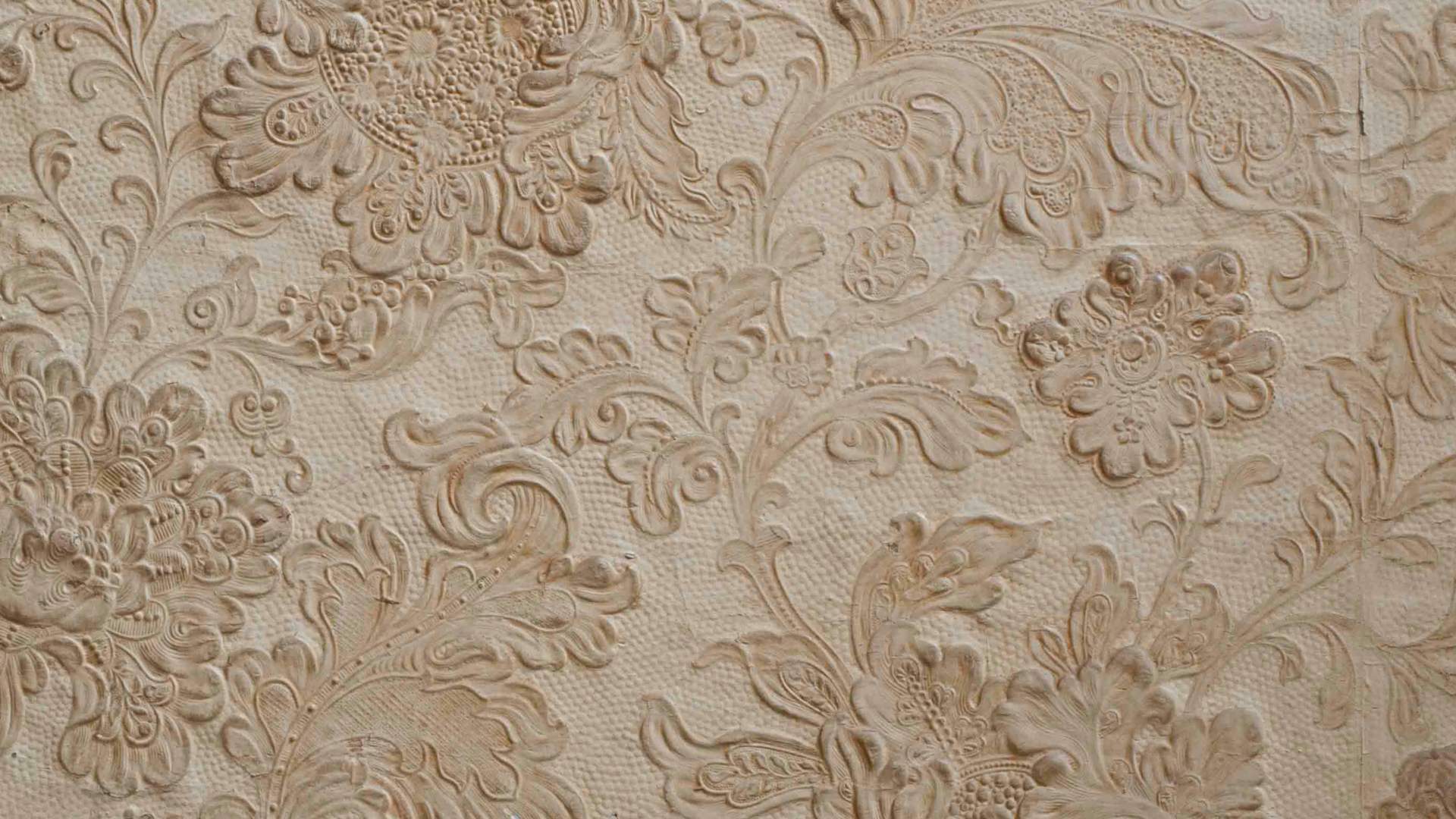
Kinkarakami is the contemporary Japanese name for gold embossed leather paper.
Embossed leather was introduced to Japan by Dutch traders in the seventeenth century. Japanese craftspeople began to experiment, recreating the leather effect in paper.
Seven years ago the Tokyo based Kinkarakami Institute was commissioned to create approximately 10 square metres of gold embossed wallpaper, recreating the pattern and texture of the original 1890s wallpaper at Rippon Lea.
The Kinkarakami Institute is a small team of two expert craftspeople – Takashi Ueda, the master of the technique, and Kazuhiro Ikeda his apprentice. The team hand-carve, emboss, varnish and paint using traditional techniques and materials. No part of the process is mechanised and the wallpaper is made primarily from plant materials.
Mulberry plant pulp(Kozo) and cereal grains are used to create the paper and the pattern is carved onto the cylindrical trunk of a specially selected cherry tree. The paper is also often ‘fixed’ using the juice of persimmons to make the backing waterproof and mould resistant.
The paper was gilded with a thin layer of tin. The damp paper then pressed – tin side down – onto the roll and beaten with special boar bristle brushes that agitated the paper fibres together to create a long continuous drop of wallpaper. The tin was varnished to transform it into a rich golden colour and lastly the background was painted.
Reviving lost techniques
Mr Ueda revived the lost techniques of Kinkarakawakami (gilt foreign leather paper) in the 1980s. Along with archival and material cultural research, he also experimented with materials. Kinkarakami (gilt foreign paper) is the contemporary version of this paper. The Institute have completed many restoration projects in Japan and are now looking to the rest of the world. The Trust’s commission is the first of its kind outside of Japan.
According to the Kinkarakami Institute, this particular pattern was created for the Emperor of Japan’s palace and features fertility symbols. The empress found the pattern too ornate and rejected it, but it proved incredibly popular in the West.
It was critical for the craftspeople to visit Rippon Lea and they took measurements and images of the pattern to assist with their carving. Mr Ueda was overcome with the scale of the Trust’s collection of Japanese paper at both Rippon Lea and Labassa, claiming that it could be the largest collection of Kinkarakawakami outside of Japan.
Of National heritage significance, Rippon Lea is a grand 19th century mansion complete with a Victorian garden to explore, heritage orchard, lake, childrens playground, fernery and grotto.